Moby Dick
Moby-Dick or, The Whale by Herman Melville
How did I get to the age of 53 and not read Moby-Dick? About time to tackle this whale of a tale.
Come on board and join me and see if you are not taken in, hook, line and sinker.

'Call me Ishmael.' The famous first line of the novel.
Ishmael is the eternal exile. Is Moby Dick a novel about such and not a story about a whale at all? The quest of each human on his own search. Are all of us 'endlessly searching through oceans of night'. Seeking answers to eternal questions...
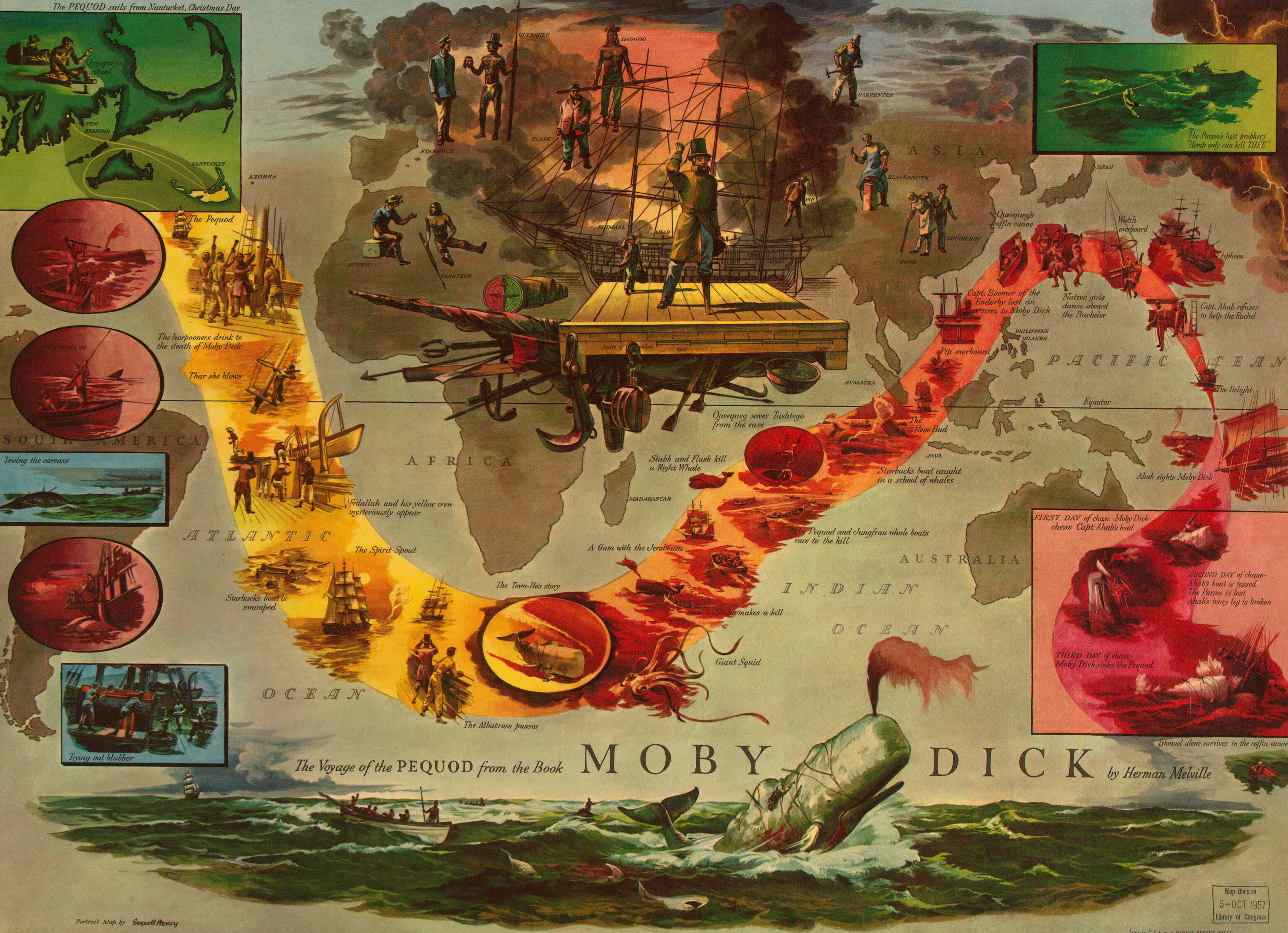
The voyage of the Pequod, Captain Ahab's ship. I love the colour coding

Ch 1-16
Best parts:
Descriptions of Queequeg. The author is pointing to judging the inner man not the exterior.
The Whaleman's chapel, it's interior decor with it's pulpit and rope ladder and painting representing a gallant ship in a terrible storm. Does this depict us? Each man a gallant ship? The gospel a pulpit into which we can climb and pull up the ladder for respite when needed?
'Yes, the World's a ship on it's passage out, and not a voyage complete; and the pulpit is its prow.'
'In this world shipmates, sin that pays its way can travel freely, and without a passport; whereas Virtue, if a pauper, is stopped at all frontiers.'
Melville writes some chapters with Dickensian humour and others with Biblical poetic beauty. Amazing the juxtaposition of the chapters as if Melville is drawing attention to the almost comic realities of life and relationships and comparing them with the great wealth of experience of the inner man and the meaning of life. Focusing on the one hand on what a man does and may choose to do with his time, and then on what a man is and may become.
ch 17-40
'If, then, to meanest mariners, and renegades and castaways, I shall hereafter ascribe high qualities, though dark; weave round them tragic graces; if even the most mournful, perchance the most abased, among them all, shall at times lift himself to the exalted mounts...then against all mortal critics bear me out, thou just Spirit of Equality, which hast spread one royal mantle of humanity over all my kind!...
Thy mighty, earthly marchings, ever cullest Thy selectest champions from the kingly commons; bear me out in it, O God!' ch 26.
ch 41-54
'he whose intense thinking thus makes him a Prometheus; a vulture feeds upon that heart forever; that vulture the very creature he creates.' Ch. 44
'the sign and symbol of a man without faith, hopelessly holding up hope in the midst of despair.' Ch. 48
ch 55-81
In chapter 55 is a discussion of past depictions of the whale, or leviathan. The picture of Perseus rescuing Andromeda by Guido Reni, 1635, is shown below.

And picture 'Perseus Descending' by Hogarth 1729


And then the head is removed:
"Speak, thou vast and venerable head…speak, mighty head, and tell us the secret thing that is in thee. Of all divers, thou hast dived the deepest. That head upon which the upper sun now gleams, has moved amid this world’s foundations…Oh head! thou hast seen enough to split the planets and make an infidel of Abraham, and not one syllable is thine! …O Nature, and O soul of man! how far beyond all utterance are your linked analogies! not the smallest atom stirs or lives in matter, but has its cunning duplicate in mind.” Ch 70.
Whales have the largest brains in the world and are five times heavier than man's.
I feel that whilst Melville is honouring the whalemen in this mighty, gory and unpleasant business of killing and butchering these great lords of the seas, he is also lamenting the need to kill these leviathans, seeing in them much to admire and respect. On the killing of an old and mighty whale who is already much maimed he says;
“But pity there was none. For all his old age and his one arm, and his blind eyes, he must die the death and be murdered, in order to light the gay bridals and other merry-makings of men, and also to illuminate the solemn churches that preach unconditional inoffensiveness to all.” ch 81
ch 82-105
Melville postulates what could be in the spout of a whale but we know today it’s a stream of warm air being forced out of the whales lungs, and since it is warmer than the air around, water vapour forms and you can get the rainbow effect sometimes seen. Different types of whales have different types of spouts.

ch 106-epilogue
We learn that Ahab the reason for Ahab not appearing for a time when the Pequod first set sail. His ivory leg had splinted and 'all but pierced his groin.' This gives a deeper meaning to his desire for revenge, for not only losing a limb but being unmanned also.
The end draws nigh with signs and portents:
1. Ahab breaks his ivory leg.
2. Queegueg has a coffin made.
3. Ahab has a harpoon made tempered in blood and 'baptised in the name of the Devil.'
4. Ahab destroys the quadrant.
5. The ship goes through a storm and experiences St Elmo's Fire.
6. Starbuck thinks of shooting Ahab.
7.The compass needles point 180 degrees the wrong way as if nature herself is trying to turn the ship around.
8. The ship loses the log and line.
9. A man falls overboard and is lost forever, and the lifebuoy also.
10. A new lifebuoy is made of the coffin
11. The Pequod meets The Bachelor which has met the while whale and lost a whale boat containing the captain's son.
12. A seabird flies off with Ahab's hat.
13. They meet the Delight who has lost 5 men to Moby Dick.
Ishmael is the eternal exile. Is Moby Dick a novel about such and not a story about a whale at all? The quest of each human on his own search. Are all of us 'endlessly searching through oceans of night'. Seeking answers to eternal questions...
The voyage of the Pequod, Captain Ahab's ship. I love the colour coding

Ch 1-16
Best parts:
Descriptions of Queequeg. The author is pointing to judging the inner man not the exterior.
The Whaleman's chapel, it's interior decor with it's pulpit and rope ladder and painting representing a gallant ship in a terrible storm. Does this depict us? Each man a gallant ship? The gospel a pulpit into which we can climb and pull up the ladder for respite when needed?
'Yes, the World's a ship on it's passage out, and not a voyage complete; and the pulpit is its prow.'
'In this world shipmates, sin that pays its way can travel freely, and without a passport; whereas Virtue, if a pauper, is stopped at all frontiers.'
Melville writes some chapters with Dickensian humour and others with Biblical poetic beauty. Amazing the juxtaposition of the chapters as if Melville is drawing attention to the almost comic realities of life and relationships and comparing them with the great wealth of experience of the inner man and the meaning of life. Focusing on the one hand on what a man does and may choose to do with his time, and then on what a man is and may become.
ch 17-40
'If, then, to meanest mariners, and renegades and castaways, I shall hereafter ascribe high qualities, though dark; weave round them tragic graces; if even the most mournful, perchance the most abased, among them all, shall at times lift himself to the exalted mounts...then against all mortal critics bear me out, thou just Spirit of Equality, which hast spread one royal mantle of humanity over all my kind!...
Thy mighty, earthly marchings, ever cullest Thy selectest champions from the kingly commons; bear me out in it, O God!' ch 26.
ch 41-54
'he whose intense thinking thus makes him a Prometheus; a vulture feeds upon that heart forever; that vulture the very creature he creates.' Ch. 44
'the sign and symbol of a man without faith, hopelessly holding up hope in the midst of despair.' Ch. 48
ch 55-81
In chapter 55 is a discussion of past depictions of the whale, or leviathan. The picture of Perseus rescuing Andromeda by Guido Reni, 1635, is shown below.

And picture 'Perseus Descending' by Hogarth 1729

Ch 56; less erroneous pictures:
By Ambroise Louis Garneray, 1783 –1857

A sperm whale:

The risks run to the whaling men were enormous when battling a sperm whale, which is a huge creature. They are discussed throughout the book and again in chapter 60, the risks of roping a whale to those in the small craft used to do so. So why take these risks? Why not battle easier prey?
A sperm whale's blunt head makes up at least a third of its body mass. Early whalers discovered the sperm whale’s head to contain the finest quality oil, called spermaceti (literally whale seed). Some 2,000 litres of it lay in a huge sac called the spermaceti organ. Unlike the oil the whalers got from rendering the blubber, spermaceti oil would not go rancid on storage and remained sweetly scented. It was used for cosmetics, pharmaceuticals and as a lubricant for clocks and watches. Spermaceti was a godsend for all these human needs, but what function did it serve for the whale?
It was believed that the sac of oil helped the whale adjust its buoyancy when it dived into the depths after its favourite prey – the giant deep-sea squid. But now it is hypothesised that is the focusing lens for the whale’s enormously powerful echolocation equipment. It is hard to study this in a dead whale but we know that dolphins, like all toothed whales, have a domed forehead that contains an oil-filled sac, which is used as part of their echolocation equipment.
The sperm whale’s sac of oil takes up almost a quarter of its entire body, whereas in a dolphin it takes up just 5% of its body volume. The most likely reason it has evolved to such an extreme size is to help the sperm whale chase down giant squid.
'All men live enveloped in whale-lines. All are born with halters around their necks; but it is only when caught in the swift, sudden turn of death, that mortals realize the silent, subtle, ever-present perils of life. And if you be a philosopher, though seated in the whale-boat, you would not at heart feel one whit more of terror, than though seated before your evening fire with a poker, and not a harpoon, by your side.'
'Consider all this; and then turn to this green, gentle, and most docile earth; consider them both, the sea and the land; and do you not find a strange analogy to something in yourself? For as this appalling ocean surrounds the verdant land, so in the soul of man there lies one insular Tahiti, full of peace and joy, but encompassed by all the horrors of the half known life. God keep thee! Push not off from that aisle, thou canst never return!' ch 58
In ch 59, the crew spot a giant squid; the sperm whale is one of the few predators of this enormous and rarely seen creature. Seeing it disturbs some of the crew.
One thing I have noted is that Melville has a lot of Biblical references but they are Old Testament rather than New Testament. The God of the Old Testament comes across as more wrathful and vengeful; an eye for an eye and all that. There is little of the New Testament approach of forgiveness and mercy.
Cutting in of a whale, like the peeling of an orange, to remove the blubber (ch 67)

And then the head is removed:
Whales have the largest brains in the world and are five times heavier than man's.
I feel that whilst Melville is honouring the whalemen in this mighty, gory and unpleasant business of killing and butchering these great lords of the seas, he is also lamenting the need to kill these leviathans, seeing in them much to admire and respect. On the killing of an old and mighty whale who is already much maimed he says;
“But pity there was none. For all his old age and his one arm, and his blind eyes, he must die the death and be murdered, in order to light the gay bridals and other merry-makings of men, and also to illuminate the solemn churches that preach unconditional inoffensiveness to all.” ch 81
ch 82-105
Melville postulates what could be in the spout of a whale but we know today it’s a stream of warm air being forced out of the whales lungs, and since it is warmer than the air around, water vapour forms and you can get the rainbow effect sometimes seen. Different types of whales have different types of spouts.

ch 106-epilogue
We learn that Ahab the reason for Ahab not appearing for a time when the Pequod first set sail. His ivory leg had splinted and 'all but pierced his groin.' This gives a deeper meaning to his desire for revenge, for not only losing a limb but being unmanned also.
The end draws nigh with signs and portents:
1. Ahab breaks his ivory leg.
2. Queegueg has a coffin made.
3. Ahab has a harpoon made tempered in blood and 'baptised in the name of the Devil.'
4. Ahab destroys the quadrant.
5. The ship goes through a storm and experiences St Elmo's Fire.
6. Starbuck thinks of shooting Ahab.
7.The compass needles point 180 degrees the wrong way as if nature herself is trying to turn the ship around.
8. The ship loses the log and line.
9. A man falls overboard and is lost forever, and the lifebuoy also.
10. A new lifebuoy is made of the coffin
11. The Pequod meets The Bachelor which has met the while whale and lost a whale boat containing the captain's son.
12. A seabird flies off with Ahab's hat.
13. They meet the Delight who has lost 5 men to Moby Dick.


Comments
Post a Comment